 Chrome Extension
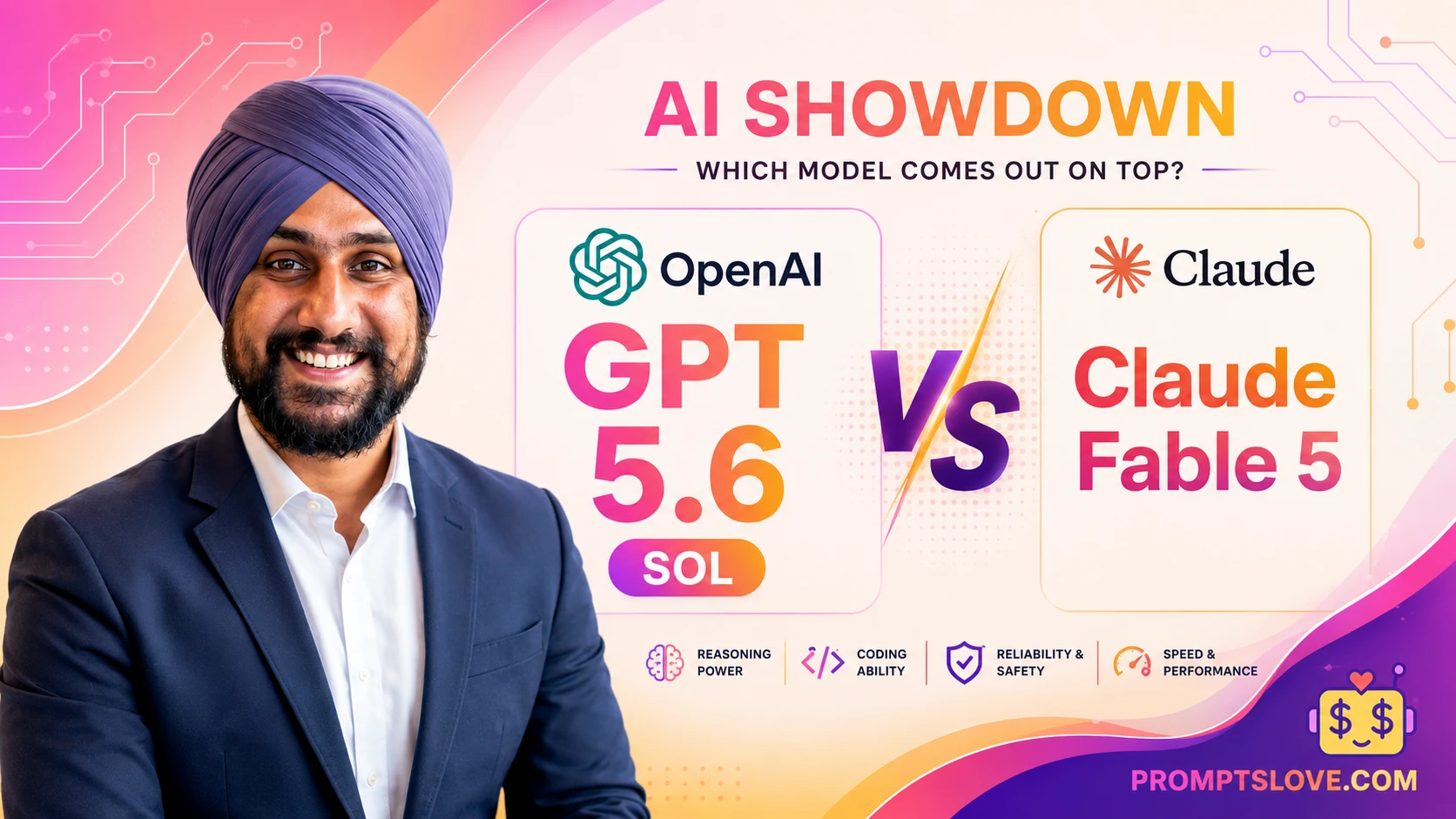
OpenAI's GPT-5.6 Sol claims to beat Claude Fable 5 on several benchmarks. I didn't believe it until I tested it myself. So I built the same two apps, a 3D portfolio website and a browser game, on both models using identical prompts, then tracked every credit each one consumed. This is the full comparison: specs, benchmarks, real output, and real cost.
If you haven't read it yet, my full GPT-5.6 Sol review covering all 5 apps has the complete build breakdown for the Sol-only side of this test. This article is about what happens when you put both models on the exact same job.
Checkout New Model - GPT 6.1 SOL Review!
Key Takeaways
Full Spec Comparison: GPT-5.6 Sol vs Claude Fable 5
| Spec | GPT-5.6 Sol | Claude Fable 5 |
|---|---|---|
| Release date | Preview June 26, 2026; GA rollout followed | June 9, 2026 |
| Context window | 1,050,000 tokens | 1,000,000 tokens (default) |
| Max output | 128,000 tokens | 128,000 tokens per request |
| Input price | $5 / 1M tokens | $10 / 1M tokens |
| Output price | $30 / 1M tokens | $50 / 1M tokens |
| Prompt caching | Cache reads at 90% discount, writes at 1.25x | $1 / 1M tokens (cache hits) |
| High-effort mode | ultra mode with subagents, max reasoning effort | Adaptive thinking (always on) |
| Positioning | OpenAI's flagship model | "Anthropic's most capable widely released model" |
Sources: OpenAI, "Previewing GPT-5.6 Sol" for Sol's release date, context window, pricing, and caching terms. Anthropic Claude Platform Docs, "Introducing Claude Fable 5 and Claude Mythos 5" for Fable 5's context window, output limit, pricing, and adaptive thinking. Anthropic, "Claude Fable 5 and Claude Mythos 5" for the June 9, 2026 launch date and positioning language.
Fable 5 is priced almost exactly double GPT-5.6 Sol across the board, confirmed directly on both companies' own pricing pages. That gap alone explains a lot of what shows up later in the credit-usage section.
Benchmark Comparison: Who Actually Wins?
Neither model wins everything, and the honest answer depends on which benchmark you trust.
| Benchmark | GPT-5.6 Sol | Claude Fable 5 | Winner | Source |
|---|---|---|---|---|
| Terminal-Bench 2.1 | New state of the art, per OpenAI | Anthropic has not published a text-stated percentage on this benchmark | GPT-5.6 Sol | OpenAI official announcement |
| ARC-AGI-1, 2 & 3 | 96.5% (ARC-AGI-1), 92% (ARC-AGI-2), 7.78% (ARC-AGI-3, first frontier model to make meaningful progress) | Not yet benchmarked on ARC-AGI as of this writing | GPT-5.6 Sol | ARC Prize Foundation, official GPT-5.6 Sol results |
| SWE-Bench Verified | Not independently published for Sol | 95.0% | Claude Fable 5 | vals.ai independent SWE-bench leaderboard (third-party, not an official OpenAI/Anthropic page) |
| SWE-Bench Pro | Reported to underperform Fable 5 | 80.3%, produced with Anthropic's own scaffolding | Claude Fable 5 | Anthropic's official Fable 5 launch post states Fable 5 is "state-of-the-art on nearly all tested benchmarks," shown in a benchmark graphic on that page rather than as text |
Both companies make their own state-of-the-art claims in their own launch materials, and neither publishes every benchmark for both models on a shared, neutral scale. OpenAI's own post confirms Sol tops Terminal-Bench 2.1 and the ARC-AGI series (the ARC-AGI numbers are further confirmed on the ARC Prize Foundation's own results page, the organization that runs that benchmark independently of OpenAI). Anthropic's own launch post claims Fable 5 is state-of-the-art on "nearly all tested benchmarks," with SWE-Bench Pro specifically flagged elsewhere as Anthropic's own scaffolding rather than a neutral harness.
During my own build, the model narrated this tension almost word for word when GPT-5.6 Sol's own output referenced its benchmark position:
"No other model can match the Fable 5, but on the benchmarks it's 5.6 beating the Fable 5. I really doubt that."
That skepticism turned out to be worth testing directly, which is exactly what the rest of this article does.
Round 1: The 3D Portfolio Website
I ran the identical prompt on both models:
Build a multi-page portfolio website called Helios with a dark,
3D animated hero section, a work/portfolio page, a case study page,
a journal/blog page, and a contact page. Use smooth scroll-triggered
animations and modern typography.
Fable 5's version was, in a word, sharper. The 3D realism in the hero section had noticeably more depth, the crisp UI held together across every page, and the light and dark mode toggle both looked deliberate rather than bolted on.
"You can see the realism in the 3D effects here, and this is not that much [from GPT-5.6 Sol]. And also scattered elements are so much that it interferes with the text you can see here, but it does not [on Fable 5]. So the flow, and also it hides all the key details at the back. So user experience is so bad [on the Sol version], and at, for this it's so good obviously [on the Fable 5 version]. So this is a frontier model from the Claude."
But the difference that actually mattered wasn't visual polish, it was judgment. GPT-5.6 Sol applied its full 3D animation treatment to every page, including the journal, a plain blog listing that never needed it. Fable 5 skipped the animation on that same page entirely, on its own, without being told to.
"GPT-5.6 added this animation on every page, even on the journal. I don't know why it required on the journal. So if I show you on general Journal, there's no animation because it's just a blog page. Why we need an animation on the journal? So it actually detects that. So that's the smartest decision made by Fable 5. So on both, I personally love Fable 5."
Round 1 winner: Claude Fable 5, on visual polish and contextual design judgment.
Round 2: The Browser Game
Second test, same prompt on both models:
Build a browser game in HTML, CSS, and JavaScript. WASD or arrow
keys for movement, spacebar for a boost, shift for a dodge move,
a health bar that reacts to damage, a first checkpoint, and
background audio.
Fable 5's build looked, in my own words, like a native app rather than a browser demo. The graphics and controls both felt intuitive from the first test.
"Wow, this looks very native app. And look at the graphics and intuitive controls, like here. This is so cool."
I tested every mechanic. The boost had visible weight and impact:
"Let me test the boost. Wow. Look at the graphics, man. No wonder it costs a lot here."
The dodge move and the damage feedback both worked cleanly too:
"Let's test the dodge. Shift. Oh, wow. Dodge is also working great. You can see the red outer frame that shows my health is decreasing. So this is cool."
Round 2 winner: Claude Fable 5 on graphics and game feel, with an explicit acknowledgment that it came at a real cost: "I obviously love Fable 5 version a lot, but it also consumed that much of credit."
The Credit Cost Comparison: Where Sol Wins Big
This is the part of the test that changes the calculus entirely.
| Metric | Claude Fable 5 | GPT-5.6 Sol |
|---|---|---|
| Apps built in this test | 1 (3D website only) | 5 (full app suite) |
| Session credits consumed | 51% | 29% |
| Weekly limit consumed | Not separately tracked | 4% |
| Plan tested | Claude subscription (same $100-equivalent tier) | Codex $100 plan |
| Per-app credit cost (rough) | ~51% for 1 app | ~5.8% average per app across 5 |
Building one website on Fable 5 used more of my session credits than building all five apps on GPT-5.6 Sol combined. That's not a rounding error, it's close to a 9x difference in credit efficiency for a comparable single build.
"In the settings, 51%. Only one thing I created using the Fable 5. You can see here, Creative Studio site. There you go. With high Fable 5 model, and it consumed my sessions 51% credits."
"If I show you from the OpenAI Codex, same plan, $100 plan, only these five apps, only 29%. So you can see, the whole five apps you saw until now only consumed 29%, and only 4% of the weekly limit."
The published API rates back this up structurally, not just anecdotally. Fable 5 bills at $10 input / $50 output per million tokens per Anthropic's own pricing, while GPT-5.6 Sol bills at $5 input / $30 output per million tokens per OpenAI's own pricing. Sol is priced at roughly half of Fable 5 on input and 60% of Fable 5 on output, and that gap compounds fast across a long agentic coding session with a large context window in play.
On top of the raw API gap, Anthropic's own redeployment announcement confirms Fable 5 was included on Pro, Max, Team, and select Enterprise plans for "up to 50% of weekly usage limits" during the period this test was run, after which further use draws from paid usage credits at the standard $10/$50 API rate. That official 50%-of-weekly-limit ceiling lines up closely with the 51% session-credit figure I saw on my own account.
"So see the difference of the pricing. And we also have this user limit resets, which we get. So it's basically unlimited credits you have for a week. So I love the pricing structure of Codex, if you compare to the Fable 5. So this is the difference between both."
Which One Should You Actually Use?
Neither model is a clean overall winner, and pretending otherwise would be dishonest.
Pick Claude Fable 5 if:
Pick GPT-5.6 Sol if:
Whichever model you land on, the single biggest lever you control is prompt quality, not model choice. A vague prompt produces the "same animation on every page" problem regardless of which model runs it. Before you burn credits testing an idea on either model, tighten the prompt first with our free ChatGPT prompt generator or free Claude prompt generator, and keep our AI Prompt Generator Chrome extension installed so you can rewrite a prompt without switching tabs mid-build.
Frequently Asked Questions (FAQs)
Is GPT-5.6 Sol cheaper than Claude Fable 5?
Yes. Per OpenAI's official pricing, GPT-5.6 Sol costs $5 per million input tokens and $30 per million output tokens, compared to Anthropic's published rate of $10 per million input tokens and $50 per million output tokens for Fable 5. In my own testing, five apps on Sol used less of my plan's credits than one comparable app on Fable 5.
Does GPT-5.6 Sol beat Claude Fable 5 on benchmarks?
It's mixed, and both companies make their own claims in their own launch materials. OpenAI's official announcement states Sol "sets a new state of the art on Terminal-Bench 2.1," and the ARC Prize Foundation's own results page confirms Sol's ARC-AGI-1 through 3 scores. Anthropic's official Fable 5 launch post claims Fable 5 is "state-of-the-art on nearly all tested benchmarks," and independent SWE-bench tracking on vals.ai puts Fable 5 at 95.0% on SWE-Bench Verified, the benchmark most closely tied to real software engineering work.
Which model has a bigger context window?
Per each company's own documentation, GPT-5.6 Sol has a slightly larger context window at 1,050,000 tokens versus Claude Fable 5's 1,000,000 tokens. Both cap output at 128,000 tokens per request.
Which model produces better-looking UI?
In my direct side-by-side test building the same website and browser game on both, Claude Fable 5 produced noticeably sharper visual polish and better contextual design judgment, including correctly skipping heavy animation on a blog page where GPT-5.6 Sol applied it everywhere.
Why did Claude Fable 5 use so many more credits than GPT-5.6 Sol?
Fable 5's official API pricing runs roughly double GPT-5.6 Sol's published rate on input tokens and about 60% higher on output tokens. In my test, that translated to one Fable 5 app consuming 51% of my session credits, compared to 29% total across five apps on GPT-5.6 Sol, a gap consistent with Anthropic's own confirmation that Fable 5 was capped at "up to 50% of weekly usage limits" on subscription plans during this period, per its official redeployment post.
Can I use both models in the same workflow?
Yes, and many builders do. Route cost-sensitive, high-volume tasks to GPT-5.6 Sol and reserve Claude Fable 5 for the smaller number of builds where visual polish or SWE-Bench-style engineering accuracy matters most.
Final Thoughts
GPT-5.6 Sol's own skepticism about beating Fable 5 on benchmarks turned out to be reasonable, Fable 5 still wins the benchmarks that track real software engineering work, and it visibly outclassed Sol on design judgment in my side-by-side build. But Sol's cost efficiency is not a minor detail, it's the difference between finishing five apps and finishing one on the same budget. If credits are your constraint, start with GPT-5.6 Sol. If polish is your constraint, budget for Fable 5. Either way, tighten your prompts first with our free prompt generator tools so the model you pick isn't fighting a vague brief on top of everything else.