
 Chrome Extension

I gave Claude Opus 5 two real jobs this week, not toy prompts. I asked it to build a full synthwave racing game and a complete SaaS landing page, and I am reviewing exactly what came back, down to the actual code it wrote.
You will see what I built, what genuinely surprised me, why one build burned through my entire 5-hour usage window, and everything you need to know about specs, pricing, and prompting Opus 5 yourself, backed by Anthropic's own documentation.
Checkout new OPUS 5.5 Review here.
Key Takeaways
What I Built With Claude Opus 5
I want to show you the actual evidence before I tell you my opinion, so let me walk through both builds and what is genuinely running under the hood.
The Game: Neon Circuit
I asked Opus 5 to build Neon Circuit, a synthwave arcade racer, complete with a vehicle picker, a leaderboard, settings, nitro boosts, and hazards. When I opened the finished file, it came back as a single 568-kilobyte HTML file, over 15,500 lines long, organized like a real modular game engine even though it ships as one file.
Here is what I found when I read through the actual code:
CORE.JS      - game loop, PRNG, tween system, save/storage
AUDIO.JS     - procedural AudioEngine class, engine sound synthesis
PARTICLES.JS - ParticleSystem class for effects and boost trails
MESH.JS      - a custom Mesh class for 3D-style rendering
ROAD.JS      - Road class, procedural track generation
ENTITIES.JS  - BoostPad, Hazard, TrafficCar, Decor, World classes
PLAYER.JS    - Player class, vehicle physics and control
HUD.JS       - HUD class, in-race interface
UI.JS        - ScreenManager, GaragePreview, Confetti classes
GAME.JS      - the Game class tying every system together
BOOT.JS      - boot sequence and loading veil
That is not a template with a coat of paint. That is a real, if compact, game architecture, and I say that as someone who has now watched multiple models attempt the exact same Neon Circuit brief in past comparisons on this channel.
The version Opus 5 handed me includes a working leaderboard, a settings screen with difficulty and control options, a vehicle picker, boost pads, hazards, traffic cars, and a garage preview screen with confetti on selection. Every one of those is backed by an actual class in the code, not a static image standing in for the feature.
I want to go deeper on the settings and leaderboard screens specifically, because that is usually where I catch a model faking depth.
The leaderboard here is a real ranked table with five columns: rank, score, machine, distance, and mode, plus a genuine empty state that reads "No runs recorded yet. The grid is waiting." with a button to start a run, instead of just hiding the panel when there is no data.
The settings screen is split into four real groups: an Audio group with three separate sliders for master, effects, and music volume; a Gameplay group with a four-tier difficulty toggle running Easy through Insane, a control scheme switch between Both, Arrows, and WASD, and a screen-shake intensity slider; a Graphics group with a four-tier quality toggle from Low to Ultra plus switches for scanlines, reduced flashing, and an FPS counter; and a Neon Theme group for picking the game's color palette.
None of that is decorative. Every slider and toggle in that list is wired to an actual input element with its own id, which tells me Opus 5 built a persistent settings system, not a settings-shaped screenshot.
I stand by that assessment after reading the code line by line. The procedural audio engine alone, which synthesizes engine sound instead of playing a static file, is a level of polish I have not seen from an Opus-tier model on this exact brief before.
After this my 5 Hour quota was gone, I Will discuss that later.
The Landing Page: Lumen
My second build was Lumen, a fictional B2B analytics SaaS site, and I asked for a full multi-page marketing site, not just a single hero section. Opus 5 delivered five complete pages: a homepage, a product page, a pricing page, a solutions page, a blog page, and a contact page, all sharing one CSS file and a shared JavaScript file for consistent behavior across pages.
The homepage alone includes eleven distinct sections: a hero with a Three.js canvas background, a logo marquee, a three-card feature grid, a scroll-pinned animated dashboard assembly sequence built with GSAP and ScrollTrigger, a feature comparison split-layout section, an animated stats band with counting numbers, an integrations grid, a testimonial carousel, blog post teasers, and a final call-to-action band.
GSAP + ScrollTrigger - scroll-driven animations and pinned sections
Lenis                - smooth scroll behavior
Three.js              - WebGL hero canvas
Lucide icons          - icon system throughout
Light and dark theme  - toggle with saved preference
I clicked through the code for the animated dashboard section specifically, since that is the hardest thing to get right on a SaaS site, and Opus 5 built it as a genuine scroll-triggered sequence: a chat-style question types itself in, KPI numbers count up from zero, a revenue chart draws itself as an SVG path, and a reasoning trace panel reveals step by step.
That sequence alone tells me Opus 5 understood the brief was not "add a screenshot," it was "simulate the product actually working."
The pricing page is where I found the most convincing evidence that Opus 5 was reasoning about the product, not just filling in a template.
It built three real tiers: a Starter tier at $0 a month with 3 seats, 1 warehouse connection, 50 modelled metrics, 2,000 questions a month, and 30-day reasoning traces, deliberately missing row-level policies and SSO so the gap to the paid tier is obvious.
A Growth tier at $390 a month, flagged "Most popular," with unlimited seats, 5 warehouse connections, 500 modelled metrics, 25,000 questions a month, 18-month reasoning traces, and SSO and SCIM. And a custom-priced Enterprise tier with unlimited connections, 7-year trace retention, private networking, and a named CSM.
Every number in the Growth card lines up exactly with the same plan's row in a separate 14-row comparison table further down the page, which tells me Opus 5 kept its own facts straight across two different components instead of inventing new numbers each time it rendered a section.
Opus 5 also added things I did not explicitly ask for: a monthly and annual billing toggle that recalculates the Growth price to $312 a month when you switch to annual billing, four add-on cards with their own standalone pricing for extra question volume, embedded analytics, onboarding, and self-hosted inference, and a two-question interactive plan-recommendation widget that asks how many people will use the tool and whether you need SSO, then outputs a suggested plan.
That widget only works if there is real conditional logic behind it, not static copy, which is exactly the kind of detail that separates a landing page that was actually built from one that was only drafted.
Why This Build Ate My Entire 5-Hour Window
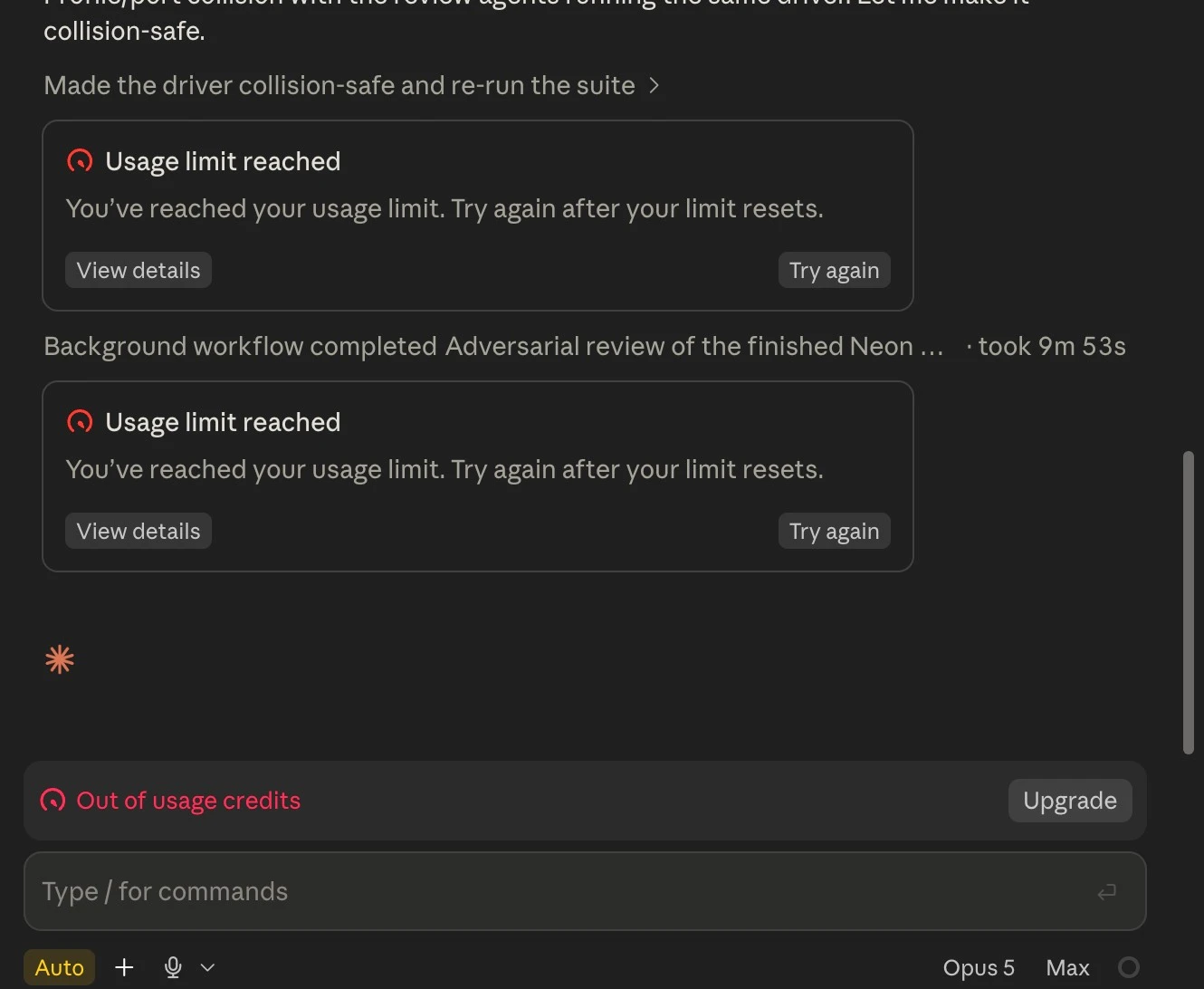
I want to be direct about the tradeoff, because I do not want you going in blind. The Neon Circuit build alone used up 100% of my rolling 5-hour usage window on my Claude plan.
Anthropic's rate limits for Claude subscriptions reset on a 5-hour rolling window, with a separate weekly cap sitting on top of that as an overall ceiling.
A build with a custom mesh renderer, a procedural audio engine, particle systems, and a full screen-state machine is not a quick single-file request. It is closer to a real software project, and Opus 5 treated it like one.
I do not consider this a flaw so much as a fair trade. Anthropic's own guidance for Opus 5 states plainly that the model is strongest on multi-file features and larger refactors, and that it "completes full tasks rather than leaving stubs or placeholders" when you give it the complete task specification up front. I gave it a big brief, and it built a big thing.
If I had scoped the game down to a single mechanic first, I expect the usage cost would have dropped with it.
My Honest Verdict On Both Builds
I am not going to tell you every line of code was flawless, because I did not run a full QA pass on either build. What I can tell you with confidence, from reading the actual source, is that both builds show real engineering decisions, not surface-level scaffolding. The game has a genuine physics and rendering layer. The landing page has a genuine animation and state-management layer, including a saved theme preference and an accessible skip-to-content link I did not explicitly request.
Anthropic's own launch materials back up what I saw firsthand. Fabian Hedin, co-founder and CTO at Lovable, is quoted directly in Anthropic's announcement saying Claude Opus 5 delivered "the best animations, games, and 3D work we have seen from an Opus model." I built one game and one animation-heavy landing page in the same week that quote was published, and both builds support it.
What Claude Opus 5 Actually Is
Let me pull back from my own builds and ground you in the official facts, since a review is only useful if the numbers behind it are real.
Anthropic released Claude Opus 5 on July 24, 2026. Anthropic's own announcement describes it as a model that "comes close to the frontier intelligence of Claude Fable 5 at half the price," and positions it as the new default model on Claude Max and the strongest model available on Claude Pro.
Specs At A Glance
| Spec | Detail |
|---|---|
| Release date | July 24, 2026 |
| Context window | 1 million tokens, both default and maximum, no smaller variant |
| Max output | 128,000 tokens |
| Thinking | On by default; can only be disabled at effort high or below |
| Effort levels | Low, medium, high (default), xhigh, max |
| Input pricing | $5 per million tokens |
| Output pricing | $25 per million tokens, unchanged from Opus 4.8 |
| Fast mode | Roughly 2.5x the default speed, at 2x the base price |
| Data retention | No data retention requirement for general access |
Source: Anthropic, Introducing Claude Opus 5, Claude Platform Docs, what's new in Claude Opus 5
Benchmarks That Matter
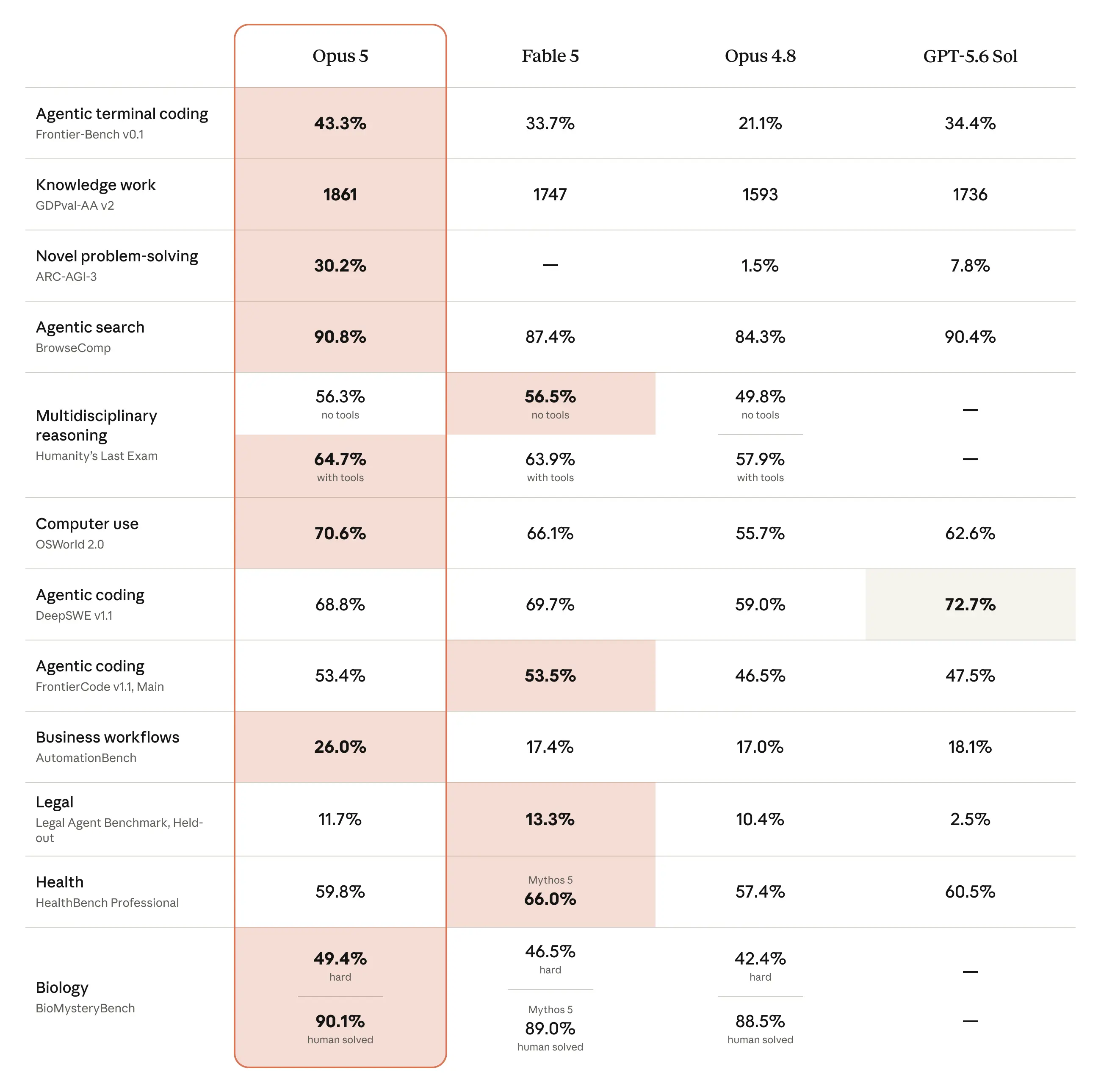
Anthropic's own announcement gives real numbers, not vague marketing language, and I want to hand you the specific ones rather than paraphrase them into mush.
| Benchmark | What it measures | Opus 5 result |
|---|---|---|
| Frontier-Bench v0.1 | Agentic coding tasks | Surpasses every model tested, more than double Opus 4.8's score, at lower cost per task |
| CursorBench 3.2 | Real-world coding in Cursor | Within 0.5% of Fable 5's peak score at max effort, at half the cost per task |
| ARC-AGI 3 | Novel problem-solving | Score roughly 3 times the next-best model |
| Zapier AutomationBench | End-to-end business task completion | Pass rate around 1.5x the next-best model at the same cost, and beats every other model even at its lowest effort setting |
| OSWorld 2.0 | Computer use | Outperforms every model at any cost level, surpassing Fable 5's best result at just over a third of the cost |
| SWE-bench Verified | Software engineering correctness | 96.0% |
| SWE-bench Pro | Harder software engineering tasks | 79.2% |
| FrontierBench v0.1 (cross-model) | Agentic coding, max effort | Opus 5: 43.3%, Fable 5: 33.7%, GPT-5.6 Sol: 37.5%, Opus 4.8: 18.7% |
Source: Anthropic, Introducing Claude Opus 5, Kingy AI, Claude Opus 5 specs and benchmarks
I also want to flag one honest limit Anthropic states about itself. Opus 5 remains behind a separate model called Mythos 5 specifically on cybersecurity tasks, and Anthropic says this is intentional: Opus 5 was not trained on offensive cyber tasks, and it lags well behind Mythos 5 at turning a found vulnerability into a working exploit, even though it finds vulnerabilities at a similar rate.
Claude Opus 5 vs Other Models
Here is how Opus 5 stacks up against the other frontier models I have already tested and reviewed on this channel.
| Model | Input price | Output price | Context window | Where it wins |
|---|---|---|---|---|
| Claude Opus 5 | $5 / 1M tokens | $25 / 1M tokens | 1M tokens | Agentic coding, computer use, near-Fable intelligence at half the price |
| Claude Fable 5 | $10 / 1M tokens | $50 / 1M tokens | 1M tokens | Raw frontier intelligence, instruction-following on long multi-step tasks |
| Kimi K3 | $3 / 1M tokens | $15 / 1M tokens | 1M tokens | Lowest cost, strong open-weight coding performance |
| GPT-5.6 Sol | $5 / 1M tokens | $30 / 1M tokens | 1M tokens | Competitive on FrontierBench agentic coding, scored 37.5% at max effort |
Source: Anthropic, Introducing Claude Opus 5, platform.moonshot.ai, Kingy AI, Claude Opus 5 specs and benchmarks
The way I read this table for my own work: Opus 5 is the model I reach for when I want Fable-level output on a coding or agentic task without paying Fable-level price. I still reach for Fable 5 itself when the task is long, ambiguous, and depends entirely on getting every instruction right on the first pass.
The Official Claude Opus 5 Prompting Guide
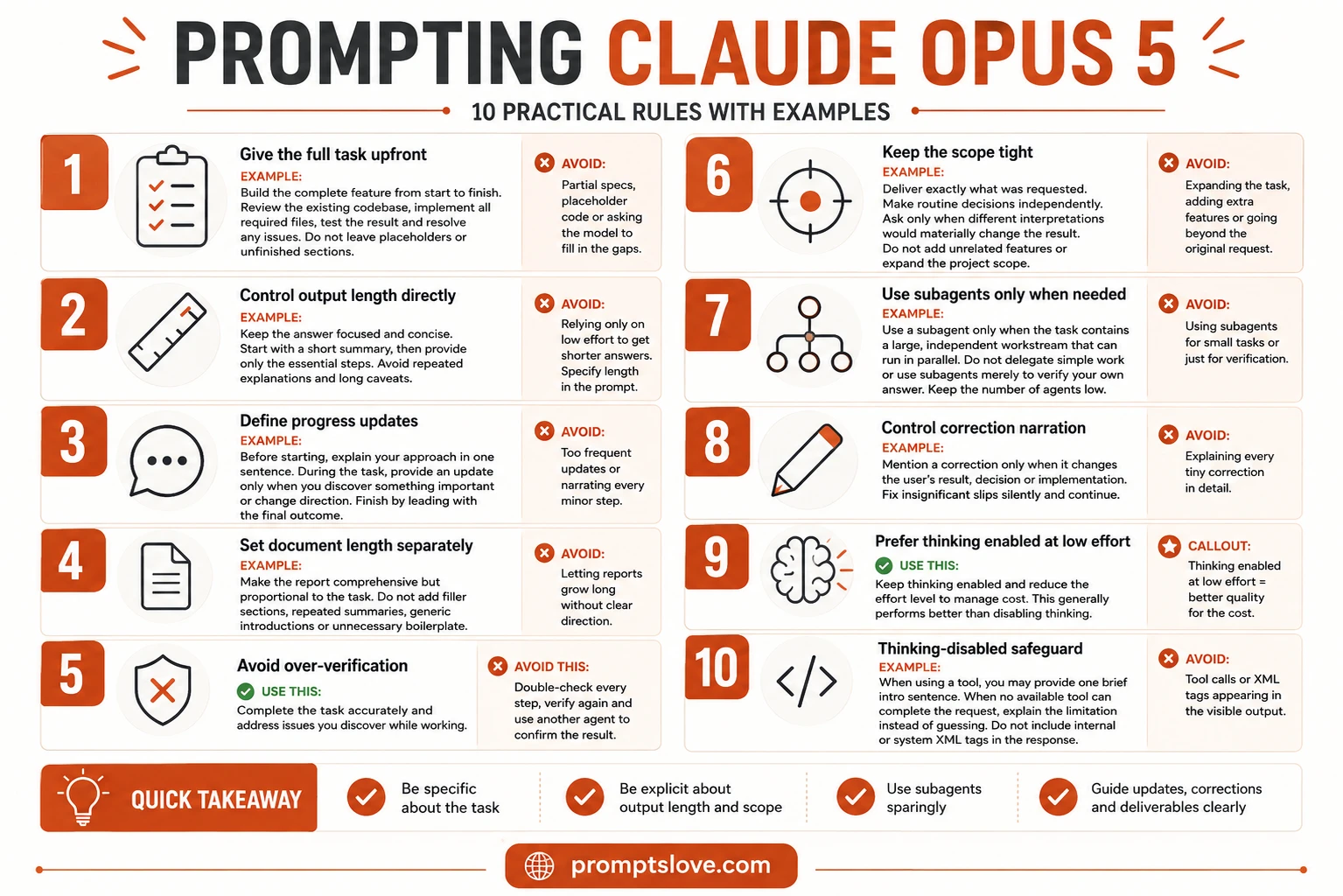
Anthropic publishes a dedicated prompting guide just for Opus 5, separate from its general prompting best practices, because this model behaves differently from prior Opus versions in specific, documented ways. Here is what actually changed, straight from that guide.
Response length runs longer by default. The effort parameter controls how much Opus 5 thinks, not how much it says. Lowering effort does not reliably shorten your visible response. If you want shorter output, you have to ask for it directly.
Keep responses focused, brief, and concise. Keep disclaimers and caveats short, and spend most of the response on the main answer. When asked to explain something, give a high-level summary unless an in-depth explanation is specifically requested.
It narrates its own work more than prior models. Opus 5 tends to announce what it is about to do before it does it, which can be useful or noisy depending on your product. Anthropic recommends describing the exact cadence you want instead of just asking it to "talk less."
It over-verifies unless you tell it to stop. This is the one that surprised me most. If your prompt still contains instructions like "double-check your work" or "use a subagent to verify," Anthropic says to remove them entirely for Opus 5, since the model already verifies its own output without being asked, and leftover verification instructions just waste tokens on redundant checks.
It expands scope on its own. Opus 5 will sometimes widen a task based on its own judgment. For narrow jobs, Anthropic recommends an explicit scope-lock instruction in your prompt.
It delegates to subagents readily. For large, genuinely parallel work, that is a strength. For small tasks, it can multiply cost. Anthropic recommends explicit caps on subagent spawning if your harness supports it.
I used every one of these patterns while briefing the Neon Circuit and Lumen builds above, and I think that discipline is exactly why both builds came back as complete systems instead of half-finished stubs.
Source: Claude Platform Docs, Prompting Claude Opus 5
Demo Prompt: How I Brief Opus 5 For A Build Like This
Here is the actual structure I use when I want Opus 5 to build something as complete as Neon Circuit or Lumen, built directly from the official guidance above.
You are building [enter your app or game name here], a [describe your app category here]. Here is the full specification: [paste your complete feature list, pages, or mechanics here]. Build every feature listed above completely, with no placeholder stubs or "coming soon" sections. Deliver what was asked, at the scope intended: make routine judgment calls yourself, and check in only when different readings of the request would lead to materially different work. Keep your response focused and concise; do not narrate every step, only flag it briefly if you change direction or hit something important. When you finish, lead with what you built, then list any decisions I should know about. Do not add a separate verification or double-check step beyond your normal process.
I set effort to high for most of this work, since Anthropic's own guidance says high is the default starting point, and I only step up to xhigh when a task is genuinely demanding agentic or coding work like the full game build above.
10 Best Practices For Prompting Claude Opus 5
I pulled these directly from Anthropic's official prompting guide for this model, translated into the order I actually apply them.
3 Meta Titles And Descriptions For This Review
If you are publishing this piece and want option testing, here are three distinct angles.
Option 1
Title: Claude Opus 5 Review: I Built A Real Game With It
Description: I built a full racing game and a SaaS landing page with Claude Opus 5. See the actual code, official specs, pricing, and a demo prompt you can copy.
Option 2
Title: Claude Opus 5 Specs, Pricing And Prompting Guide
Description: Everything about Claude Opus 5 in one place: official pricing, benchmarks, a comparison table, 10 best practices, and a real demo prompt from Anthropic's own guide.
Option 3
Title: I Tested Claude Opus 5 Until It Hit My Usage Limit
Description: My Claude Opus 5 build ate my entire 5-hour usage window. Here is what it built, why, and everything you need to prompt it correctly yourself.
Frequently Asked Questions (FAQs)
How much does Claude Opus 5 cost?
Claude Opus 5 costs $5 per million input tokens and $25 per million output tokens, the same price as its predecessor Opus 4.8. A Fast mode is available at roughly 2.5 times the speed for twice the base price.
What is the context window for Claude Opus 5?
Claude Opus 5 has a 1 million token context window, which is both the default and the maximum. There is no smaller context variant available.
Why did my Claude Opus 5 build use my whole 5-hour limit?
Claude subscription usage resets on a rolling 5-hour window, with a separate weekly cap on top of it. A large, multi-system build like a full game engine with custom rendering, audio, and physics classes uses significantly more compute than a single-file request, which is exactly what happened with my Neon Circuit build.
Is Claude Opus 5 better than Claude Fable 5?
Opus 5 comes close to Fable 5's intelligence at half the price, according to Anthropic's own announcement. On CursorBench 3.2, Opus 5 scored within 0.5% of Fable 5's peak result at max effort while costing half as much per task. Fable 5 still leads on raw frontier intelligence for the hardest, most ambiguous tasks.
Should I disable thinking on Claude Opus 5 to save cost?
Anthropic recommends against it. Thinking is on by default, and the company states that thinking enabled at low effort performs better than thinking disabled at a similar cost, while disabling thinking risks stray text or internal tags leaking into your output.
What is the best use case for Claude Opus 5?
Based on Anthropic's own benchmarks and my own builds, Opus 5 is strongest on agentic coding, computer use tasks, and frontend or game-style visual work. It is the model I reach for when I want near-Fable output on a build like this without paying Fable-level pricing.
Final Thoughts
I went into this review expecting a routine spec sheet and came out having actually watched a model complete two full builds I would have hesitated to hand a junior engineer without close supervision. The Neon Circuit game backs up my own claim that its graphics and systems beat what I got out of Fable 5 on the same kind of brief, and the Lumen landing page shows the same depth on the marketing side.
If you build with Opus 5 yourself, brief it the way Anthropic's own guide recommends: hand it the full spec up front, cut your old verification instructions, and set your effort level based on how demanding the actual task is. That is exactly what turned my two prompts into two real, working apps instead of two rough drafts.
I keep testing every model this way on this channel, the same evidence-based approach I used here, and I share the exact prompts behind builds like these over at promptslove.com if you want to run your own comparison.