 Chrome Extension

I kept seeing "loop engineering" pop up in my feed this year, and I did what I do with every new AI term before I repeat it to you: I dug into where it came from, checked whether real labs back it, and then tested it myself against a normal prompt on the same task.
You are about to get the full result of that dig, including the actual outputs I pulled from ChatGPT for one live use case, five more use cases with both prompt styles ready for you to copy, and an honest verdict on when looping is worth your time and when it is just extra steps.
Key Takeaways
What Is Loop Engineering, Really?
Let me be straight with you before I sell you on anything. Loop engineering is not a term you will find published on anthropic.com, openai.com, or google.com as an official framework. I want you to know that upfront, because I would rather tell you the truth than make a new buzzword sound more official than it is.
Here is what actually happened.
Developer Peter Steinberger posted on X on June 7, 2026, that developers should stop prompting coding agents directly and instead design loops that prompt agents for them.
The post reportedly reached over 2 million views. Around the same time, Boris Cherny, who leads Claude Code at Anthropic, was quoted making a nearly identical point about no longer prompting Claude directly but running loops that prompt it for him.
Google Cloud AI director Addy Osmani picked up the term the same week and published the most detailed public breakdown of it, describing loop engineering as a system built from five repeatable parts: automations, worktrees, skills, plugins or connectors, and sub-agents, plus a persistent memory layer he calls the spine.
I left that empty prompt block there on purpose, the same way I do in every guide I publish. You will see real prompts, not placeholders, starting in the use case section below.
IBM published an official explainer on the term on July 17, 2026, through IBM Think, which is the closest thing to a large enterprise vendor validating the phrase. I want to flag honestly that this piece sits closer to product education tied to IBM's own coding agent than to independent research.
So here is my honest read for you. Loop engineering describes something real and useful. The term itself is about six weeks old at the time I researched this, popularized by individual engineers on social media rather than defined in a peer-reviewed paper or an official lab framework.
Sources: Addy Osmani, Loop Engineering, IBM Think, What Is Loop Engineering?
What Traditional Prompt Engineering Actually Means
Now let me ground you in the term loop engineering gets compared against, because I think most people using "prompt engineering" loosely have never read how the major labs actually define it.
Google's own Gemini documentation defines prompt engineering directly as "the iterative process of repeatedly updating prompts and assessing the model's responses."
Notice that word iterative is already in the official definition. The difference is not iteration versus no iteration. The difference is who does the iterating.
Anthropic's official prompt engineering documentation frames a prompt as a first draft you improve against defined success criteria, refined by you, the human, between attempts.
OpenAI's official prompt engineering guide lists six concrete strategies: write clear instructions, provide reference text, split complex tasks into simpler subtasks, give the model time to think, use external tools, and test changes systematically.
Every one of those strategies still assumes a human sits between each attempt, reads the output, and decides what to change next. That is the real definition of traditional prompt engineering: one prompt in, one output out, and a person manually deciding whether round two is needed.
Sources: Google AI for Developers, prompting strategies, Anthropic, prompt engineering overview, OpenAI, prompt engineering guide
The Real Difference Between Loop Engineering And Prompt Engineering
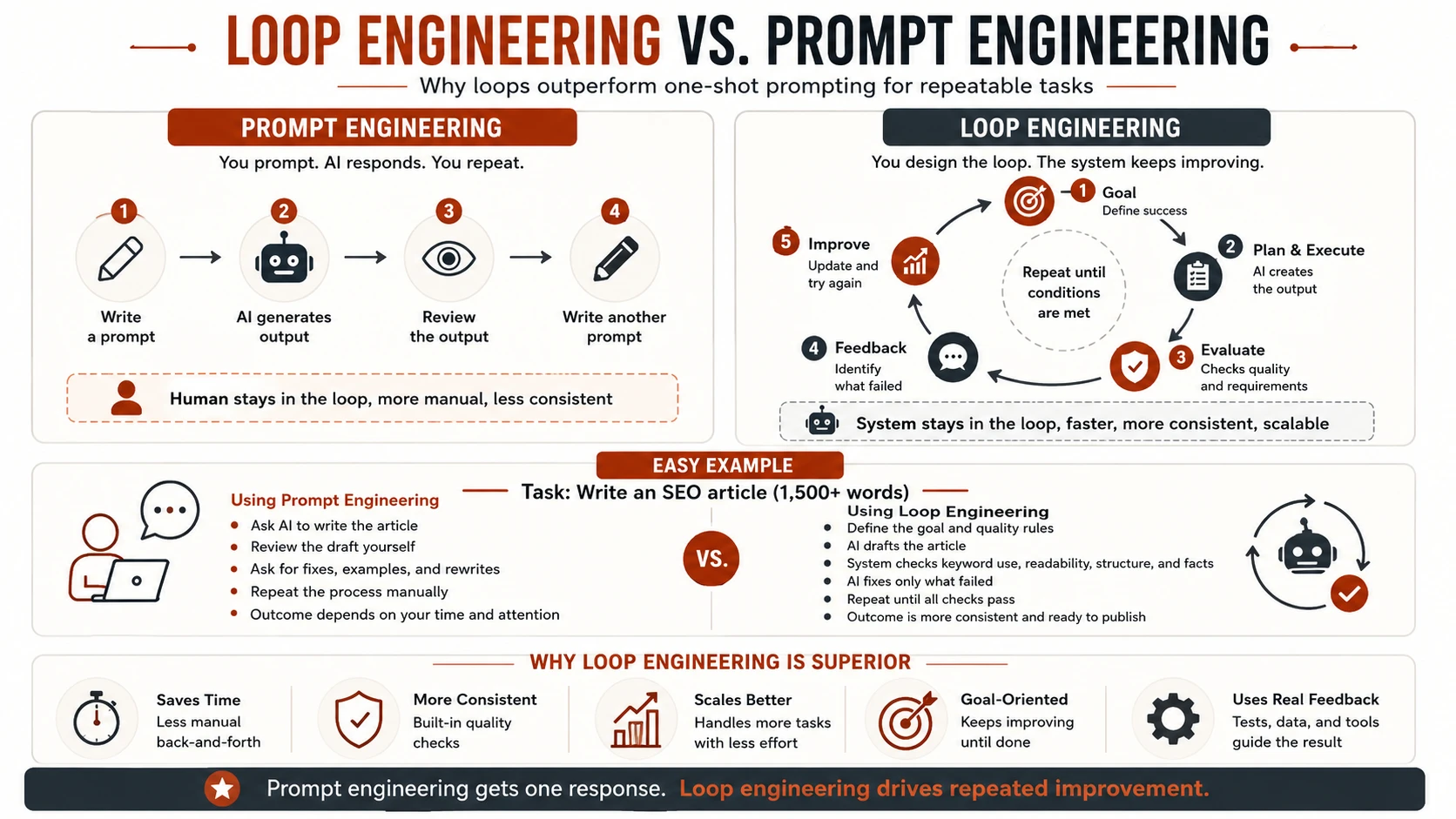
Here is the comparison I wish someone had shown me before I spent a week reading about this. I built this table directly from the official sources above plus Anthropic's engineering documentation on agent design.
| Traditional prompt engineering | Loop engineering | |
|---|---|---|
| Structure | One prompt in, one output out | Generate, evaluate, refine, repeat until a stop condition |
| Who iterates | You, manually, between each attempt | The system itself, largely without you in the loop |
| Official backing | Documented by OpenAI, Anthropic, and Google as their core prompting guidance | Coined on social media in June 2026, described in detail by an individual Google Cloud AI director, referenced by IBM's education content |
| Closest real framework | Role, instructions, context, examples | Anthropic's evaluator-optimizer pattern, academic self-refine and reflexion research |
| Cost and speed | Lower cost, lower latency, one model call | Anthropic states this explicitly trades latency and cost for better task performance |
| Best for | Quick tasks, simple requests, anything you can verify yourself in seconds | Tasks with clear evaluation criteria, longer content, code that needs to actually run correctly |
Sources: Anthropic, building effective agents
Now that you can see the structural difference on paper, let me show you where that structure actually comes from in the research, since loop engineering did not appear out of nowhere.
The Academic Foundation Behind Loop Engineering
I want you to understand something important. The mechanic behind loop engineering has existed in published AI research since 2023, three years before the term itself caught on. Here are the four pieces of research and official documentation that actually explain why looping works.
Anthropic's evaluator-optimizer workflow. Anthropic's own engineering blog describes agents as systems that are "typically just LLMs using tools based on environmental feedback in a loop." Their evaluator-optimizer pattern has one model call generate a response while a second call evaluates and gives feedback, looped until the output clears the bar. Anthropic recommends this specifically when "iterative refinement provides measurable value."
Self-Refine. Researchers Madaan and colleagues published Self-Refine in 2023, testing a single model that generates, critiques its own output, and refines it, with no extra training required. Across seven tasks, human and automatic judges rated the refined outputs roughly 20% better on average than the first-pass output. One task, dialogue response quality, jumped from a score of 25.4 to 74.6 after the refinement loop.
ReAct. Yao and colleagues published ReAct in 2023, interleaving reasoning steps with actions so the model plans, acts, observes the result, and adjusts its next step. ReAct beat standard chain-of-thought prompting on knowledge-heavy tasks and outperformed baselines on interactive tasks that required multiple steps to complete correctly.
Reflexion. Shinn and colleagues published Reflexion in 2023, where an agent writes a verbal reflection on why an attempt failed, stores it, and uses that reflection on the next attempt instead of retraining the model. Reflexion pushed one coding benchmark, HumanEval, to a 91% pass rate, well above the roughly 80% baseline reported for GPT-4 without the reflection loop.
| Study | What it tested | Result | Source |
|---|---|---|---|
| Self-Refine | 7 tasks including dialogue and code optimization | Roughly 20% average improvement over one-shot output | arXiv:2303.17651 |
| Reflexion | Coding and reasoning tasks | 91% pass rate on HumanEval, versus roughly 80% baseline | arXiv:2303.11366 |
| Self-Debug | Code generation benchmarks | Up to 12 percentage points higher accuracy | arXiv:2304.05128 |
| Constrained copy generation | Marketing and ad copy under format constraints | 16.25% to 35.91% higher constraint-success rate | arXiv:2504.10391 |
That last study is the one that mattered most to me, because it tests almost the exact scenario I was about to run myself: copywriting under strict format constraints. So instead of just repeating that number to you, I decided to reproduce it on my own task and show you the receipts.
I Tested Both Approaches On ChatGPT. Here Is What Actually Happened
I opened two fresh ChatGPT conversations and ran the identical task both ways. The task was writing Facebook ad primary text for a 48-hour flash sale on a productivity app called FocusFlow, offering 30% off annual plans, targeting busy professionals who struggle with time management, each option under 125 characters with a clear call to action.
The Traditional Single-Shot Prompt
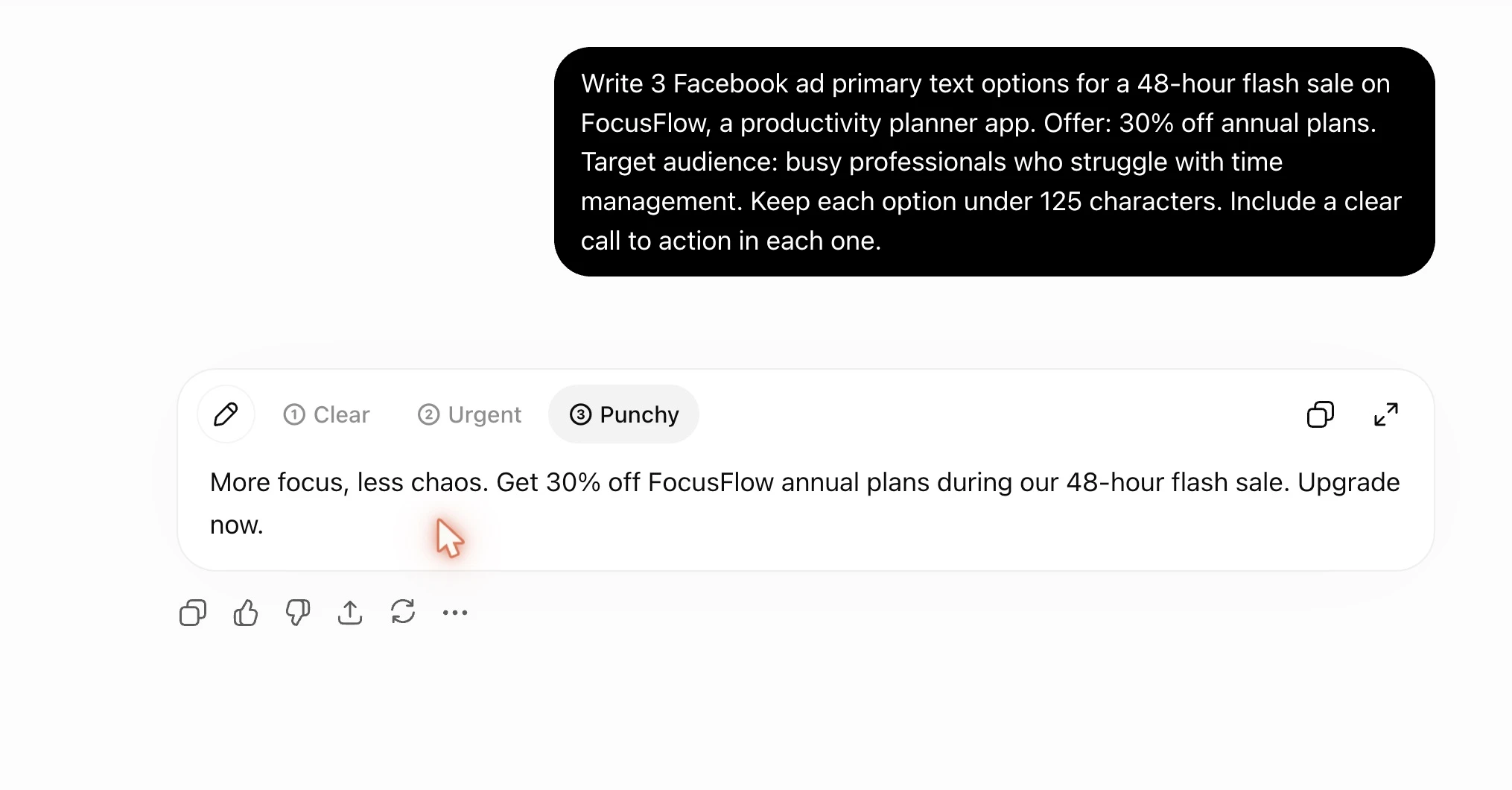
Write 3 Facebook ad primary text options for a 48-hour flash sale on [enter your product name here], a [enter your product category here]. Offer: [enter your discount or offer here]. Target audience: [describe your target audience here]. Keep each option under 125 characters. Include a clear call to action in each one.
Here is exactly what ChatGPT gave me back, with no follow-up from me:
Clear: "Your day is busy. Your plan shouldn't be. Get 30% off FocusFlow annual plans for 48 hours. Start now." (101 characters) Urgent: "Stop letting your schedule run you. Save 30% on FocusFlow annual plans for 48 hours. Claim your offer today." (108 characters) Punchy: "More focus, less chaos. Get 30% off FocusFlow annual plans during our 48-hour flash sale. Upgrade now." (102 characters)
All three respected the 125-character limit. All three included a call to action. This is genuinely solid, usable output from one prompt, and I want to give ChatGPT credit for that before I show you the difference.
The Loop-Engineered Prompt
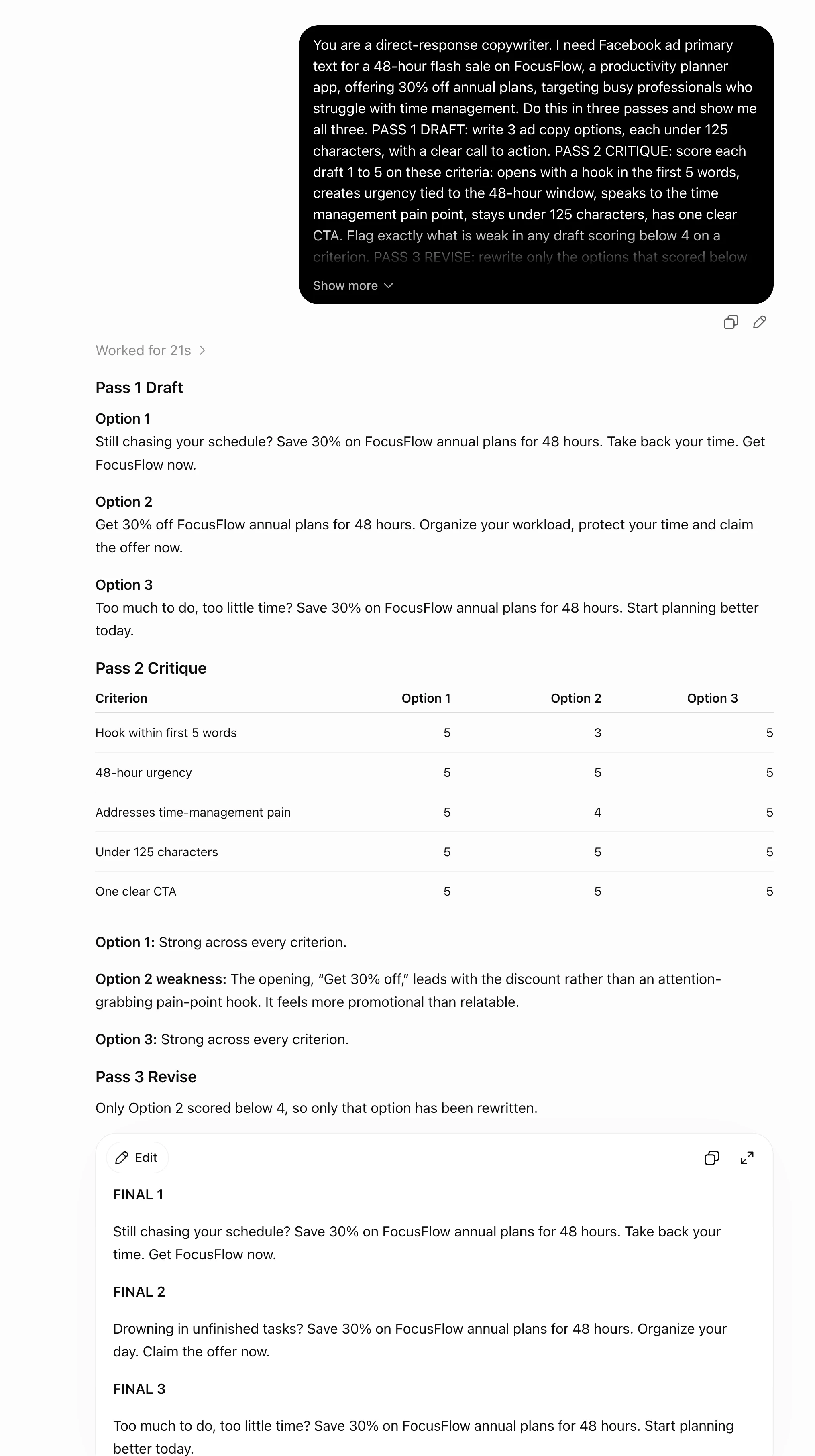
You are a direct-response copywriter. I need [describe your ad format here] for [describe your offer...

[Sign up to unlock the full prompt]
I ran the filled-in version of that same prompt, and ChatGPT worked through all three passes inside one response. Here is Pass 1, the initial draft, before any self-critique:
Option 1: "Still chasing your schedule? Save 30% on FocusFlow annual plans for 48 hours. Take back your time. Get FocusFlow now." Option 2: "Get 30% off FocusFlow annual plans for 48 hours. Organize your workload, protect your time and claim the offer now." Option 3: "Too much to do, too little time? Save 30% on FocusFlow annual plans for 48 hours. Start planning better today."
Then, without me asking a second time, it graded its own drafts against the five criteria I gave it in the prompt: a hook in the first five words, urgency tied to the 48-hour window, a clear speak to the time-management pain point, staying under the character limit, and one clear call to action.
Option 1 and Option 3 scored a clean 5 out of 5 on every criterion. Option 2 scored a 3 out of 5 on the hook criterion specifically, and ChatGPT explained exactly why in its own words:
"The opening, 'Get 30% off,' leads with the discount rather than an attention-grabbing pain-point hook. It feels more promotional than relatable."
Then it moved to Pass 3 and rewrote only Option 2, leaving the two strong drafts untouched:
FINAL 1: "Still chasing your schedule? Save 30% on FocusFlow annual plans for 48 hours. Take back your time. Get FocusFlow now." (117 characters, unchanged) FINAL 2: "Drowning in unfinished tasks? Save 30% on FocusFlow annual plans for 48 hours. Organize your day. Claim the offer now." (118 characters, revised) FINAL 3: "Too much to do, too little time? Save 30% on FocusFlow annual plans for 48 hours. Start planning better today." (110 characters, unchanged)
What This Actually Proves
I want to be careful here and not oversell what I just showed you. The traditional single-shot prompt produced three usable ad lines with no errors. I would happily run any of them.
But the loop version did something the single-shot version structurally cannot do: it caught its own weakest line, told me exactly why the line was weak using the criteria I gave it, and fixed only that specific problem while leaving the strong drafts alone. That is not a vague quality improvement I am asking you to take on faith. You can see the exact before and after above, and every option from both tests stayed within the 125-character limit I set.
This matches what the arXiv research above documents almost exactly. Self-Refine's mechanism is generate, then critique against explicit criteria, then revise only what fails, and that is precisely the sequence I watched happen in front of me on a real marketing task.
5 Use Cases With Both Prompts, So You Can Test This Yourself
I built five more prompt pairs across the domains the research actually covers, so you can run your own side-by-side test the same way I just did. Each pair uses the exact same task, once as a traditional single-shot prompt, once structured as a loop.
Use Case 1: Blog Post Editing
Traditional prompt
Edit this blog post draft for clarity and flow: [paste your draft here]. Fix any awkward sentences and improve the overall readability.
Loop-engineered prompt
Here is a blog post draft: [paste your draft here]. PASS 1 EVALUATE: score this draft 1 to 5 on structure, redundancy, evidence and specificity, and voice consistency with this style: [describe your desired tone here]. Name the single weakest section. PASS 2 REVISE: rewrite only the weakest section you identified, keeping everything else in the draft unchanged. PASS 3 CONFIRM: re-score the revised draft on the same four criteria and confirm every score is now 4 or above, or repeat the revision on whatever still scores below 4.
Use Case 2: Code Debugging
Traditional prompt
Here is my code: [paste your code here]. It is producing this error: [paste your error message here]. Fix it.
Loop-engineered prompt
Here is my code: [paste your code here]. It fails with this error: [paste your error message here]. PASS 1 DIAGNOSE: explain the root cause of this specific error, not just a generic description. PASS 2 FIX: write a corrected version of the code. PASS 3 VERIFY: trace through the corrected code line by line against the original error to confirm the exact failure condition no longer occurs, and flag if any edge case could still break it.
Use Case 3: Research Synthesis
Traditional prompt
Summarize this research on [enter your topic here] and give me the key findings: [paste your sources or notes here].
Loop-engineered prompt
Here is my research on [enter your topic here]: [paste your sources or notes here]. PASS 1 DRAFT: write a synthesis covering the key findings. PASS 2 CRITIQUE: check the draft against these criteria: does every claim trace back to a specific source, are conflicting findings across sources acknowledged rather than smoothed over, is the summary free of unsupported generalizations. Flag any section that fails a criterion. PASS 3 REVISE: fix only the flagged sections and present the final synthesis.
Use Case 4: Data Analysis Summary
Traditional prompt
Here is my data: [paste your data here]. Analyze it and tell me what stands out.
Loop-engineered prompt
Here is my data: [paste your data here]. PASS 1 ANALYZE: identify the 3 most significant patterns or anomalies. PASS 2 CHALLENGE: for each pattern you identified, check whether it could be explained by a confound, a small sample size, or a seasonal effect, and note if it can. PASS 3 FINALIZE: present only the patterns that survive your own challenge in step 2, and state your confidence level in each one.
Use Case 5: Customer Support Response
Traditional prompt
Write a response to this customer complaint: [paste the complaint here]. Our policy is: [describe your policy here].
Loop-engineered prompt
Here is a customer complaint: [paste the complaint here]. Our policy is: [describe your policy here]...

[Sign up to unlock the full prompt]
Run any of these pairs yourself on the same task and compare what comes back. That direct comparison is more convincing than anything I can tell you in this article.
When Loop Engineering Is Worth It, And When It Is Not
I do not want to leave you thinking you should loop every single prompt from now on, because the research does not support that, and neither does what I just watched happen in my own test.
Anthropic states this directly in its own engineering documentation: agentic and looped systems trade latency and cost for better task performance. Every extra pass is an extra model call, and extra time waiting.
The research also shows diminishing returns. Self-Refine's own analysis found improvement shrinks with each additional round. A separate study on self-correction found most of the gain happens on the first correction pass, with only marginal improvement by the third through fifth attempt. Self-Debug reported that most coding fixes converge within three rounds, which tells you round four and beyond are rarely worth the extra cost.
So here is how I actually decide. I reach for a loop when the task has a clear, checkable standard, like a character limit, a passing test suite, or a specific tone I can score against. I skip the loop and use a single traditional prompt when the task is quick, low-stakes, or something I can eyeball and fix myself faster than writing three passes of instructions.
The Failure Modes Nobody Talks About
I also want to flag two risks I found in my research that most loop engineering hype does not mention. IBM's own explainer names a real failure mode it calls comprehension debt, where you let a loop run so many autonomous passes that you stop understanding what changed between the first draft and the final output. IBM also names cognitive surrender, where you stop reviewing looped output entirely because the process looks sophisticated, and let mistakes ship that a single glance would have caught.
A separate piece of research backs this up with data, not just a warning. A study on self-improving systems found that large jumps in a model's own verification accuracy, as much as 20 points, produced student-model gains of 4 points or less, and documented cases where self-improving systems actually regressed on new tasks instead of getting better. Looping is not automatically safe just because it sounds more rigorous than a single prompt.
That is exactly why I read every pass in my own test above instead of only checking the final output. The FINAL 2 revision looked better to me on inspection, not just because ChatGPT said it scored higher.
Source: When Good Verifiers Go Bad, arXiv:2606.14629, IBM Think, What Is Loop Engineering?
Frequently Asked Questions (FAQs)
Is loop engineering an official AI industry term?
Not yet, and I think you deserve that honesty. It was coined by developer Peter Steinberger in June 2026, expanded by Google Cloud AI director Addy Osmani, and referenced by IBM's education content in July 2026. No major AI lab has published it as an official framework name, though the underlying mechanic is well documented under other names.
What is the closest official name for loop engineering?
Anthropic's own term is the evaluator-optimizer workflow, where one model call generates output and a second call evaluates and gives feedback in a loop. In academic research, the same mechanic appears as self-refine, ReAct, and reflexion, all published years before the term loop engineering existed.
Does looping actually improve output quality?
Yes, based on published research. The Self-Refine paper measured roughly 20% average improvement across seven tasks, and a copywriting-specific study measured 16% to 36% higher constraint compliance from iterative refinement versus single-pass generation. My own live test showed the same pattern on a real ad copy task.
Does loop engineering cost more than traditional prompting?
Yes. Anthropic states directly that agentic and looped systems trade latency and cost for better performance, since every additional pass is an additional model call. I only use a loop when the task has a clear standard worth that extra cost.
How many loop passes should I run before I stop?
Research suggests diminishing returns after the third pass. Self-Debug found most coding fixes converge within three rounds, and a separate self-correction study found gains mostly happen in the first correction with only marginal improvement afterward. I build my own loop prompts around three passes for that reason.
Can I use loop engineering with any AI platform?
Yes. The version I tested runs as a single message on ChatGPT, and the same three-pass structure works on Claude, Gemini, or any chat-based model. You do not need special tooling to try it, though dedicated agent tools like Claude Code build looping in automatically for coding tasks.
Final Thoughts
I went into this expecting to find either an overhyped buzzword or a genuine shift in how I should be prompting. What I found was closer to the second thing, with an honest asterisk: loop engineering is a new name for a technique that real research has backed since 2023, and my own live test on ChatGPT showed exactly the mechanism the research describes, a model catching its own weak line and fixing only that line.
You do not need to loop every prompt you write starting today. You need to know when a task has a real standard to check against, and reach for one of the loop prompts above when it does.
I will keep testing new terms the same way I tested this one, on a real task, with the real output shown to you instead of a summary of someone else's claim. That is the only way I know to tell you the truth about whether a new technique is worth changing how you work.
Every prompt structure in this article, both the traditional version and the loop version, follows the same strategy I use across all 29,000+ prompts and automations inside my library. If you want the full collection built this same evidence-based way, get access here: https://members.promptslove.com/register